
Tuesday, October 31, 2006
Educational : Size Comparison of some largest Aircrafts
A size comparison of some of the largest aircraft in the world. The Airbus A380-800 (largest airliner), the Boeing 747-8, the Antonov An-225 (aircraft with the greatest payload) and the Hughes H-4 "Spruce Goose" (aircraft with greatest wingspan).


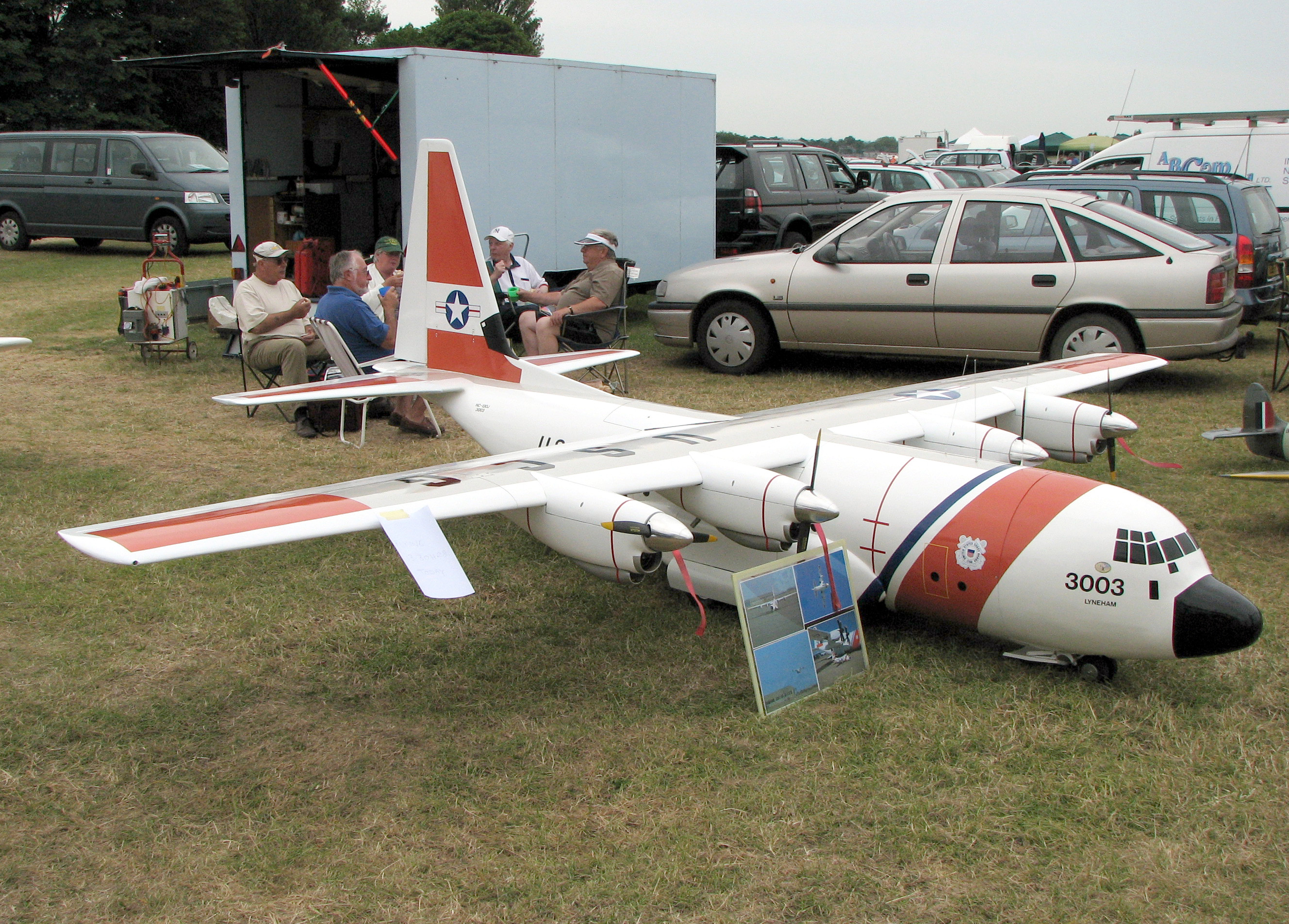
Model aerodynamics
Model aerodynamics
The flight behavior of an aircraft depends on the scale to which it is built. The Reynolds number depends on scale and speed. Drag is generally greater in proportion at low Reynolds number so flying scale models usually require larger than scale propellers.
Mach number depends on speed. Compressibility of the air is important only at speeds close to or over the speed of sound, so the effect of the difference in Mach number between a slow piloted aircraft and a small model is negligible, but models of jets are generally not efficient flyers. In particular, swept wings and pointed noses are used at high Mach number to reduce compressibility drag and tend to increase drag at small Mach number.
Angular momentum also depends on scale. Since torque is proportional to lever arm length while angular inertia is proportional to the square of the lever arm, the smaller the scale the more quickly an aircraft or other vehicle will turn in response to control or other forces. While it may be possible for a pilot to fly an unstable aircraft (such as a Wright Flyer), a radio control scale model of the same aircraft would only be flyable with the center of gravity moved forward. Static stability, resisting sudden changes in pitch and yaw, is generally required for all models and is usually considered a requirement for piloted aircraft. Dynamic stability is required of all but tactical piloted aircraft.

Free flight models need to have both static and dynamic stability. Static stability is the resistance to sudden changes in pitch and yaw and is typically provided by the horizontal and vertical tail surfaces, respectively, and by a forward center of gravity. The three dynamic stability modes are phugoid, spiral and Dutch roll. An aircraft with too large horizontal tail may have a plugoid with increasing climbs and dives. Insufficient dihedral and sweep back will generally lead to increasing spiral turn. Too much dihedral generally causes Dutch roll. However, these all depend on the scale, as well as details of the shape and weight distribution. For example the paper glider shown here is a contest winner when made of a small sheet of paper but will go from side to side in Dutch roll when scaled up even slightly.
Electric power Aircrafts
Electric power Aircrafts

In electric-powered models, the powerplant is a battery-powered electric motor. Throttle control is achieved through an electronic speed control (ESC), which regulates the motor's output. The first electric models were equipped with DC-brushed motors and rechargeable packs of nickel cadmium (NiCad), giving modest flight times of 5-10 minutes. (A fully-fueled glow-engine system of similar weight and power would likely provide double the flight-time.) Later electric systems used more-efficient brushless DC motors and higher-capacity nickel metal hydride (NiMh) batteries, yielding considerably improved flight times. The recent development of lithium polymer batteries (LiPoly or LiPo) now permits electric flight-times to approach, and in many case surpass that of glow-engines. There is also solar powered flight, which is becoming practical for R/C hobbyists. In June 2005 a new record of 48 hours and 16 minutes was established in California for this class.
Electric-flight was tested on model aircraft in the 1970s, but high-cost prevented widespread adoption within the industry until the early 1990s, where falling costs of motors, control systems and, crucially, more practical battery technologies came on the market. Electric-power has made substantial inroads into the park-flyer and 3D-flyer markets. Both markets are characterized by small and lightweight models, where electric-power offers several key advantages over IC: greater efficiency, higher reliability, less maintenance, much less messy and quieter flight. The 3D-flyer especially benefits from the near-instantaneous response of an electric-motor. As the size of a model aircraft increases, the cost of electric-flight increases much more rapidly than traditional glow-engine flight. As of 2005, an electric-flight conversion for mid-large scale-models (above 0.60in3 glow-engine) is prohibitively expensive (>$400 USD.) Most such models remain powered by the venerable glow-engine, as their pilots prefer the sound and smell of a genuine 2 or 4-stroke IC-engine.
Aircrafts with Jet and rocket
Jet and rocket

A recent development is the use of small jet turbine engines in hobbyist models, both surface and air. Model-scale turbines resemble simplified versions of turbojet engines found on commercial aircraft, but are in fact new designs (not based upon scaled-down pre-existing commercial jet engines.) The first hobbyist-developed turbine was developed and flown in the 1980s by Gerald Jackman in England, but only recently has commercial production made turbines readily-available for purchase. Turbines require specialized design and precision-manufacturing techniques (some designs for model aircraft have been built from recycled turbocharger units from car engines), and consume a mixture of A1 jet fuel and synthetic motorcycle-engine oil. These qualities, and the turbine's high-thrust output, makes owning and operating a turbine-powered aircraft prohibitively expensive for most hobbyists. Jet-powered models attract large crowds at organized events; their authentic sound and high-speed make for excellent crowd pleasers.
Pulse jet engines, operating on the same principle as the WW II V-1 flying bomb have also been used. The extremely-noisy pulsejet offers more thrust in a smaller package than a traditional glow-engine, but is not widely used. A popular model was the "Dynajet".
Rocket engines are sometimes used to boost gliders and sailplanes. In the 1950s, a type of model rocket motor called the Jetex engine was quite popular. Today, flyers mount readily-available model rocket engines to provide a single, short (<10second) burst of power. However, government regulations and restrictions have rendered rocket-propulsion unpopular even for gliders.
Subscribe to:
Posts (Atom)

